Pollution can be defined as the environment's desfavorable alteration or degradation due to the introduction of new noxious chemical substances or to the excessive use of old ones. The human activity, specially motor vehicles and chemical industries are responsible for most of the pollution produced nowadays. Pollution has been always considered as part of our growth, because in order to expand companies and sell products advertisement is needed, most of the time this advertisement comes in new packages which lead people throw the old item, even if it still works to then get a new one and this increases contamination.
There are 3 main types of pollution.
 |
| Air pollution, that includes the pollution of the atmosphere |
 |
| Water pollution which means the contamination of rivers, lakes and oceans |
 |
There are other types of pollution such as soil and radioactive contamination, as an example there is the Japanese nuclear disaster in 2011. There is also:
- Heat pollution which can be created by the movement of people;
- Light pollution which "refers to any outdoor light that creates glare and interferes with the natural night environment" (Marie Lenahan, 2011);
- Nano-pollution which is the name given to all the waste generated by nanodevices or during the materials manufacturing process
- Noise pollution that is the excessive noise created by either humans or animals which, disrupts the activity or balance of nature's life
- Visual pollution are the man-made elements that interrupts with the natural landscape.
Consequences
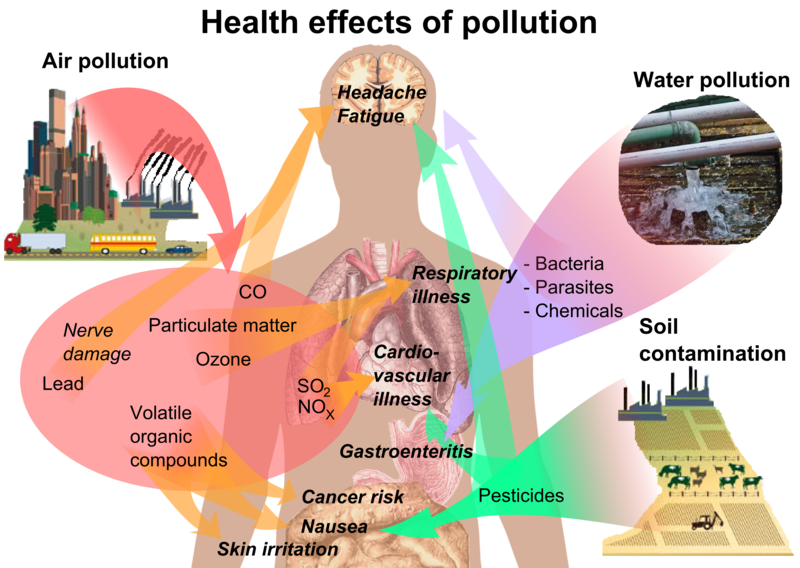
Pollution brings all kind of deceases to people as well as animals. As the illustration shows, almost all kind of pollution causes headache and fatigue; the strong chemicals, such as those found in pesticides can cause nausea and cardiovascular illness. The CO (cobalt), SO2 (sulfur dioxide, also found on volcanos) and NOx (oxides of nitrogen) contained in polluted air can easily cause respiratory illness, cancer risks and skin irritation. The bacterias and parasites found in dirty water usually cause gastroenteritis when drunk.
Something people do not care about or are not able to see is that, the most affected people are in the low-class sector. It is known that "air pollution kills 15000 bangladeshis each year" (academicjournals.org, 2011) because they do not have proper housing and they are exposed to all the residues around the area, specially dust and smoke from factories. This do not stop people from building more companies and it also does not encourage them to take measures to clean the environment. What's more 884 million people lack acces to clean water but an stimate of 3.575 million of the people who can drink it die each year from a water related disease.
Renewable energy as key to "stop" pollution
Along with developing environmental conscience, renewable energy which is the energy that comes from natural resources such as sunlight, wind and water. Pollution would increase at first when the industries start constructing the needed systems for the improvement and better use of energies. Afterwards, when most people and industries adapt themselves to the new technology and it has spread along the continents, the pollution situation should improve. The focus is not in completely stop the contamination because by this time it is extremely advanced, therefore the issue will be managed step by step.
Technology for a sustainable development
Bioengineering
|
There is a
growing need to reduce dependency on fossil fuels with
renewable resources, which help diversify the energy portfolio to ensure a
constant energy supply even during times of crisis. Dr. Nancy
Ho at Purdue University received a TSE grant to further
develop a yeast-based ethanol synthesis process. Dr. Ho has genetically
engineered or "bioengineered" yeast to more efficiently convert
cellulosic plant material into ethanol, an alternative transport fuel that
can be used directly or blended with gasoline. The use of ethanol has the
further advantage of reducing dependency on foreign sources of oil, thus
protecting the nation's energy security and reducing the trade deficit caused
by importing oil.
|
Chemical
Improvements
|
The pulp and
paper industry uses organic
solvents to remove lignin, the color-causing substance in
wood, from paper. The use of these solvents can result in the production of . Dr. Robin
Rogers of the University of Alabama-Tuscaloosa received a TSE
grant to develop an environmentally benign water-based system for the removal
of lignin. Dr. Rogers' new process more efficiently removes color from pulp
without the use of organic solvents, thus eliminating the production of
dioxins and reducing the sulfur content of paper, making both the process and
the product more environmentally friendly.
|
Green
Design and Industrial Ecology
|
Green design and
industrial ecology aim to manage the environmental impact of an industry
using a systems approach, in which the acquisition, use, and disposal of
water, energy, and materials and the relationships among them are documented,
evaluated, and optimized. Dr. David
Dornfeld at the University of California-Berkeley received a
TSE grant to develop a comprehensive tool to assess the environmental impacts
of semiconductor manufacturing. Environmental issues in semiconductor
manufacturing addressed by the work include the release of potent global warming gasses and
wastewater
pollutants. The aim of Dr. Dornfeld's research is to support
decisions that avoid negative impacts such as global warming and polluted
wastewater, and conserve water, energy, and materials.
|
Fuels and
Energy
|
The burning of fossil fuels produces
noxious gasses such as sulfur oxides ,
which contribute to acid rain. Conventional
sulfur-removal technology is not able to easily reduce fuel sulfur levels to
EPA standards. Dr.
Chunshan Song and colleagues at Pennsylvania State University
received a TSE grant to develop a new process that will efficiently remove
the sulfur. The process under development is able to more selectively remove
sulfur compounds under ambient temperatures and pressures, thus reducing the
cost and energy of sulfur removal.
|
Conclusion
Pollution will get worse in order to improve, but also there is not enough environmental conscience in people's mind. Even if they say they care about the issue, they would not stop or change until a large amount of people start it before. Individuals must learn about the topic because the consequences are worse, too many people, animals and living species are dying everyday. The needed machinery is already developed therefore companies need to start using it and spread the word so other industries which help pollution stop as soon as possible.

No comments:
Post a Comment